Unsupported Browser
The American College of Surgeons website is not compatible with Internet Explorer 11, IE 11. For the best experience please update your browser.
Menu
Become a member and receive career-enhancing benefits

Our top priority is providing value to members. Your Member Services team is here to ensure you maximize your ACS member benefits, participate in College activities, and engage with your ACS colleagues. It's all here.

Become a Member
Become a member and receive career-enhancing benefits

Our top priority is providing value to members. Your Member Services team is here to ensure you maximize your ACS member benefits, participate in College activities, and engage with your ACS colleagues. It's all here.

Become a Member
ACS
Resources for Journalists

Media Resources on Surgery

Every year, more than 15 million Americans have some type of surgery. The American College of Surgeons, the largest professional association of surgeons in the world, has several resources and experts available for reporters interested in writing stories that provide readers with in-depth analysis and practical tips for understanding surgery. Media members may contact pressinquiry@facs.org to schedule an interview with one of our experts.

Raising Standards in Surgery

The ACS operates 13 quality programs rooted in evidence-based standards designed to improve the quality of surgical care provided to patients at hospitals around the country. Our experts are available for interviews on a diverse range of topics related to surgery, from improved trauma and cancer care to effective ways to prevent surgical complications in vulnerable populations, such as children and older adults.

  • Understanding the changing landscape of cancer care: An estimated 1 in 3 Americans will be diagnosed with cancer in their lifetime, and approximately 5.4% of the U.S. population is living with a history of cancer – a percentage expected to rise exponentially in the coming decade. While new cancer treatments are improving survivorship, access to cancer treatments and specialists remains highly fragmented. The ACS Commission on Cancer, National Accreditation Program for Breast Centers, and National Accreditation Program for Rectal Cancer set standards for more than 1,400 cancer centers across the country, focusing on disease prevention, treatment, and survivorship. Journalists may reach out to the ACS Public Information team for the latest information on cancer care in the U.S., including the unique challenges faced by young adults with cancer and those living in rural communities.
  • Raising standards in trauma care: Unintentional injuries from trauma, including motor vehicle crashes, firearm injuries and falls, are the leading cause of death in the U.S. in people under 45. The ACS Trauma Verification, Review, and Consultation Program and Trauma Quality Improvement Program are dedicated to defining the best structures and processes for trauma care. Journalists may contact the ACS Public Information team to connect with trauma surgeons at the forefront of advocating for improved access to trauma care and prevention.
  • Tracking key surgical data: Data from the National Surgical Quality Improvement Program (NSQIP), a comprehensive data registry that tracks hospital and patient demographics and metrics, has been used in more than 1,500 peer-reviewed studies, helping inform and improve quality at surgical departments across the country. Journalists may contact the ACS Public Information team for more information on understanding NSQIP data.

Quitting Smoking

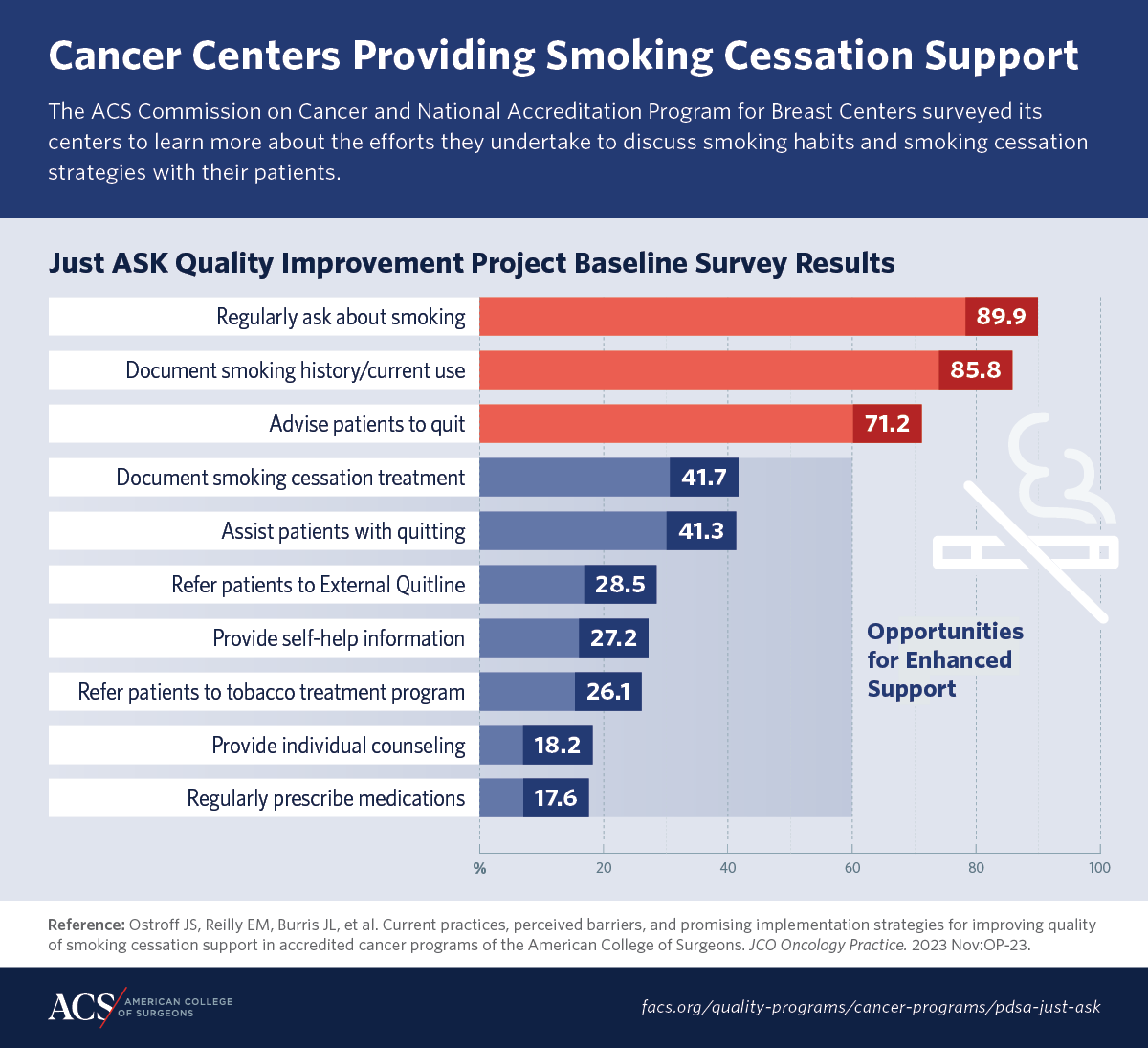
The American College of Surgeons is a leader in efforts to promote smoking cessation, especially during the critical moments when a person is about to undergo surgery and those facing a cancer diagnosis. The ACS Just ASK and Beyond ASK quality improvement initiatives are the largest national efforts of their kind designed to improve access to smoking cessation resources available to cancer patients. ACS experts are available for interviews on why quitting smoking is one of the most beneficial habits a person can do to transform their health. Our experts can also provide ways to provide practical and empathetic support to people looking to quit smoking.

Smoking facts:

  • Smoking is known to cause 12 different types of cancer, including lung cancer.
  • Continued smoking can negatively affect cancer treatment. Stopping smoking can improve survival.
  • Quitting smoking at any time reduces your risk of dying from other diseases besides cancer, including heart disease and pulmonary disease.
  • Most adults who smoke cigarettes report wanting to quit, but fewer than one in ten succeed in quitting each year, according to the Centers for Disease Control and Prevention.
  • There are several different treatment options to promote quitting smoking, including medication, counseling, and social support.