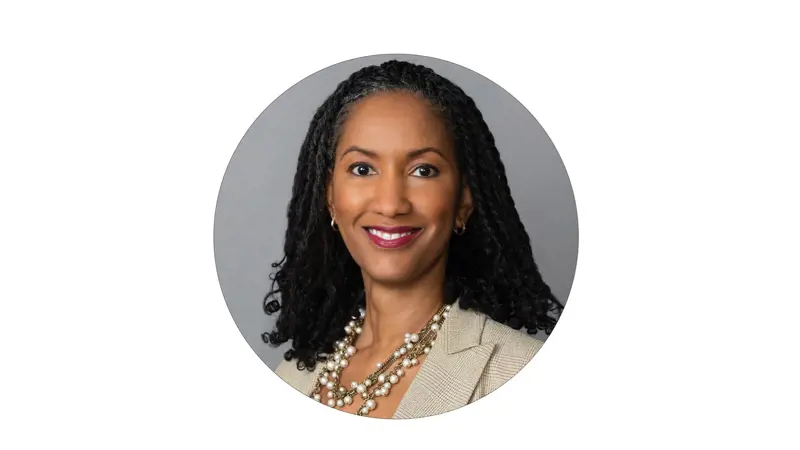
Dr. Carrie Cunningham and a colleague take a moment after a successful day in the OR.
Surgeons Reveal Stories of Struggle and Strength
Carrie Cunningham, MD, MPH, FACS, past-president of the Association for Academic Surgery (AAS), shared her experiences with depression and substance use disorder and described a pivotal moment along her journey to mental wellness that occurred as she delivered her AAS presidential address in February 2023.
“Beyond bringing my two children into the world, giving this address was the most important thing that I had ever done,” she said. “From that day until now, I continue to receive emails, letters, and calls from those in crisis. I began my speech like this: ‘Yes, I was a top junior tennis player at the age of 16, and I competed at Wimbledon five times. I am an associate professor of surgery at Harvard Medical School, and I am the president of the Association for Academic Surgery—and I am also human. I am a person with lifelong depression, PTSD, and now a substance use disorder. None of my professional successes have protected me against this.’”
The title of her 50-minute speech, “Removing the Mask,” has generated more than 70,000 views to date on YouTube.
Dr. Sangki Oak intubates a foreign fighter that was injured while ambushing a nearby unit in Bala Murghab, Afghanistan.
“My intention in continuing to tell my story is to provide a voice for those of you who suffer silently,” explained Dr. Cunningham. “It has been shown time and again that experiencing a major medical error is something that we take home, we take it personally, and we rarely grieve. But there are things that are under our control. Live with intent, with overarching principles and boundaries, and find people who inspire you and support you. Practice mindful self-leadership. As leaders and allies, I urge you to become as knowledgeable about mental health disease as you are about every other disease. Psychological first aid should be a requirement.”
The key to mitigating the hidden emotional burdens carried by many surgeons is to first acknowledge their unprecedented role within the domain of healthcare. Surgeons perform in high-stakes environments in which they routinely manage life-and-death decisions and shoulder substantial accountability for patient outcomes.
“The unique and silent struggles of the surgeon include excessive workload, responsibility for patient outcomes, and a lack of a work-life balance—all of these can take a toll on a surgeon’s mental health,” said Kamal M. F. Itani, MD, FACS, session comoderator. “It is imperative that we acknowledge these challenges and have the resources to address these mental issue needs in order to protect our well-being.”
Dr. Sangki Oak operates with another resident on a patient at BWH.
Sangki Oak, MD, MPH, provided the resident perspective on maintaining mental wellness. Dr. Oak—a former Special Amphibious Reconnaissance Corpsman with US Marine Special Operations—served in multiple deployments in Afghanistan after 9/11.
“My name is Sangki Oak. I’m a fifth-year surgical resident at Brigham and Women’s Hospital (BWH) in Boston, a combat military veteran, and I have a mental illness,” said Dr. Oak. “My journey from the military to surgical residency has resulted in mental illnesses that have ended up severely affecting my life and my performance and have even led me to being held back in my program. I’m here because I want to help others avoid the same challenges I went through and that some have not survived.”
Although the data can vary depending on specialty and other factors, one study found that 75% of general surgery residents demonstrated signs of burnout, and 40% exhibited symptoms of depression.
“When I got back from Afghanistan, I felt that I made it through my service relatively unscathed. I didn’t have nightmares. I didn’t jump at loud noises. I wasn’t abusing drugs or alcohol. And I had a plan,” said Dr. Oak. “But during the beginning of medical school, I started questioning my life, and I found that I missed the military, so I began developing suicidal ideation. There were several times when I sat at the edge of my bed with my pistol in my hand contemplating putting a bullet in my head.”
The ABCs for Supporting Surgeons Experiencing Emotional Distress
Dr. Oak started seeing a psychiatrist through Veterans Affairs, and he eventually matched in surgery at BWH in 2020.
“I’ve been asked by my fellow residents whether I found residency or the military harder. I tell them that, for me, general surgery residency has been harder than war. I felt a greater sense of camaraderie in the military. We relied on and trusted the person to your left and to your right and would do anything to protect them. And while I feel that patient care is a team effort, I’ve observed a culture in surgery that often dictates that ‘I’ am the only one who can save the patient, so we are bred to not trust anyone else.”
Dr. Oak noted that while the miliary employs a “crawl, walk, run” approach to learn complex actions, like learning how to shoot a firearm, surgical residents are “thrown in the fire early in their training.”
He also described how the concept of grit during residency training is a double-edged sword because, while it allows people to push farther, it also propels them to push past their limits. Grit, in this context, is often described as a deep commitment to achieving long-term goals, with an enduring ability to recover from failure, setbacks, and adversity.
“I believe that the characteristics of smart, motivated, and driven people with high standards for themselves—traits that epitomize almost all surgical residents—can lead to constant denial of our mental state,” explained Dr. Oak. “We tell ourselves that ‘I’m okay. I’m fine’ and put on a strong face to the rest of the world. Of course, since everyone has this strong façade, people think that everyone else is doing fine so I should be fine too. We then fool ourselves and just keep our heads down and survive because it’s only a certain number of years of residency, and then it gets better. Though it’s questionable if it really does.”
Dr. Oak’s dual background in military service and medical training has given him a unique vantage point to compare how each system addresses mental health.
“Surgical training is tough as it is, and the culture can make it tougher than it needs to be. It even ended up breaking a decorated, war-hardened, special operations veteran like myself,” said Dr. Oak. “To those who know they’re hurting, I implore you to find help before it gets worse. For those of you who think you’re fine, I ask you to take a good, hard look at yourself and how you act in the OR and with others. You may be struggling more than you would care to admit. The first step to healing is acknowledging what is going on inside yourself. While my journey has been tough, I truly believe that in the end, I’ll be a better provider, surgeon, and person because of all this.”
Don’t Medicalize Suffering, Humanize It
Surgeons can start their journey toward improved well-being by understanding the profound difference between pain—a physical sensation—and suffering—a broader emotional and psychological experience.
Dr. Mary Brandt suggests mental wellness begins with discovering root causes for suffering and pain.
“Pain is a normal part of the practice of surgery,” said Mary L. Brandt, MD, MDiv, FACS. “We experience physical pain from ergonomic injury or medical-related causes; we experience emotional pain from the suffering our patients endure; and we experience spiritual pain from moral distress or the inability to find meaning.”
Dr. Brandt suggested the surgical community adopt a person-centered approach for mitigating mental distress experienced by a colleague, which takes into account potential root causes for suffering and pain.
“What we tend to do as doctors, and it’s completely understandable, is that we medicalize suffering, particularly in our colleagues. We want a diagnosis, we want a prognosis, we want to treat it, we want to know what the outcome is. We put it into the same box we put breast cancer,” explained Dr. Brandt. “We medicalize suicidal ideation and say, ‘If only they had gotten treatment and if only they had been on the right medication, this would have never happened.’”
To support surgeons in emotional distress, Dr. Brandt suggested following the ABC approach: Act if there is there is imminent danger to yourself or others; Be present (listen attentively and do not try to fix the situation); and let Compassion arise.
“How do you let compassion arise? Bear witness and don’t look away. Choose to feel empathy—and then tolerate the discomfort that arises in response to your empathy. Any pain—physical, emotional, spiritual—that causes intense suffering can lead to the inability to see beyond that suffering,” Dr. Brandt said, while also urging surgeons to help their colleagues determine the source of their pain.
“There comes a point where we need to stop just pulling people out of the river. We need to go upstream and find out why they’re falling in,” she said, quoting bishop and theologian Desmond Tutu.
Dr. Tasha Hughes underscores the importance of self-assessment tools to sustain emotional well-being.
Mental Health Maintenance Starts with Preventive Approach
Determining the root cause of emotional distress can help inform preventive mental healthcare.
“Surgeons, at our core, are helpers and healers, and because of that, we often need to suppress or compartmentalize our emotions,” said Tasha Hughes, MD, FACS. “It’s really important to stop and name your emotions: are you mad, are you sad, are you overwhelmed? Are you happy, are you proud? I think it’s good to name all of them, and there are lots of ways to do this.”
Some emotional self-assessment tools could include patient-facing validated screens such as the Patient Health Questionnaire, also known as the PHQ-2, or burnout scales such as the Utrecht Burnout Scale. Other assessments are designed specifically for physicians, including resources developed by the American Medical Association, the ACS, and other organizations.
Boundary setting is another essential component of preventive care. Executed correctly, establishing boundaries is a form of decision-making that should be revisited on a routine basis.
Dr. Stanley Ashley emphasized the importance of integrating surgeon mental health into the C-suite leadership strategy.
“Boundary setting is not a one and done action,” she said. “It needs to be revisited monthly, quarterly, annually, because as we all know, in healthcare, the work is boundless. There is an unlimited number of patients, so therefore, you have to set boundaries because you are not limitless.”
Dr. Hughes mentioned a colleague who has a quarterly alarm set on their calendar as a reminder to examine their current workload.
“The notification simply says ‘reassess.’ No one else is on the invite. It is an opportunity for this individual to review what is on their plate right now. Is it the right mix? Is it a mix that is making me happy? Is there something that needs to go away professionally so that I can prioritize my identity outside of surgery?”
Despite the strides taken to help surgeons overcome the stigma associated with mental distress, this cultural change continues to be a delicate undertaking for some.
“This is a professional shift, and it does feel uncomfortable for a lot of people,” Dr. Hughes said. “Emotional self-regulation, for me, has been a big part of my breaking through those dark first years as a faculty member. Doing it for yourself is enough. Your health is enough. And we’re also doing it so that we are here to take care of patients for the long haul.”
Rethinking the C-Suite’s Role in Sustaining Surgeon Mental Health
During his tenure as chief medical officer at BWH (2011–2019), Stanley W. Ashley, MD, FACS, helped develop the BWH Faculty/Trainee Mental Health Program to address increased concerns regarding physician burnout and its impact on mental well-being. The program, launched in 2017, offers a free 30-minute virtual consultation without notes in the electronic health record. If continuing care is requested, up to six virtual sessions with a psychiatric care provider or a referral to an outside provider are available to the individual.
“I think the program at the Brigham is something almost every academic institution should have,” said Dr. Ashley, who also was vice chair of surgery at BWH 2003–2011.
“It behooves us to think about what we can do specifically to support surgeon mental well-being, and I don’t think that can come from the C-suite, surgical chair, division chief, or the program director,” he said, calling for new roles at large academic institutions, such as a surgical mental health officer or a peer support officer, to adequately support the needs of faculty, trainees, and staff.
He noted that programs that specifically address surgeon depression and suicide ideation should offer resources that describe “the continuum of distress, from depression to suicide, particularly by surgeons with experience.”
Dr. Timothy Mahoney calls for surgeons to support each other’s wellness with the same vigor that members of police departments typically support one another.
Closing out the session, Timothy Mahoney, MD, FACS, mayor of Fargo, North Dakota, and the session’s comoderator, presented a brief video highlighting the Fargo Police Department’s Wellness Initiative, which supports the physical, mental, and emotional health of its officers and civilian staff through peer counseling, training, and other services. Dr. Mahoney cited the initiative as an example of the kind of unwavering and profound emotional support surgeons should provide to their colleagues experiencing burnout and emotional distress.
The ACS provides resources on mental health, emotional well-being, suicide prevention and awareness, and more: facs.org/wellbeing/.
Tony Peregrin is the Managing Editor, Special Projects in the ACS Division of Integrated Communications in Chicago, IL.
Bibliography
Frangou C. US surgeons are killing themselves at an alarming rate. One decided to speak out. Daily Guardian. September 26, 2023. Available at: https://www.theguardian.com/us-news/2023/sep/26/surgeons-suicide-doctors-physicians-mental-health. Accessed October 22, 2025.
Williford ML, Scarlet S, Meyers MO, et al. Multiple-institution comparison of resident and faculty perceptions of burnout and depression during surgical training. JAMA Surg. 2018; 153(8):705-711.