The medical record has come a long way in the past 3 decades. It has transitioned from hand-written notes in a paper chart, stored remotely, and plagued by documentation compliance shortcomings, to an electronic health record (EHR) that is more readily interpretable and accessible.
Clinical reports are now distributed in near real-time so professionals can view them at workstations, while patients simultaneously can view them using smartphone applications. Unsurprisingly, as the medical record has evolved, so have expectations regarding the purpose and functions of the record.
Indeed, it is increasingly expected that the medical record will support the patients’ needs related to healthcare information no matter when, where, or with whom they seek care.
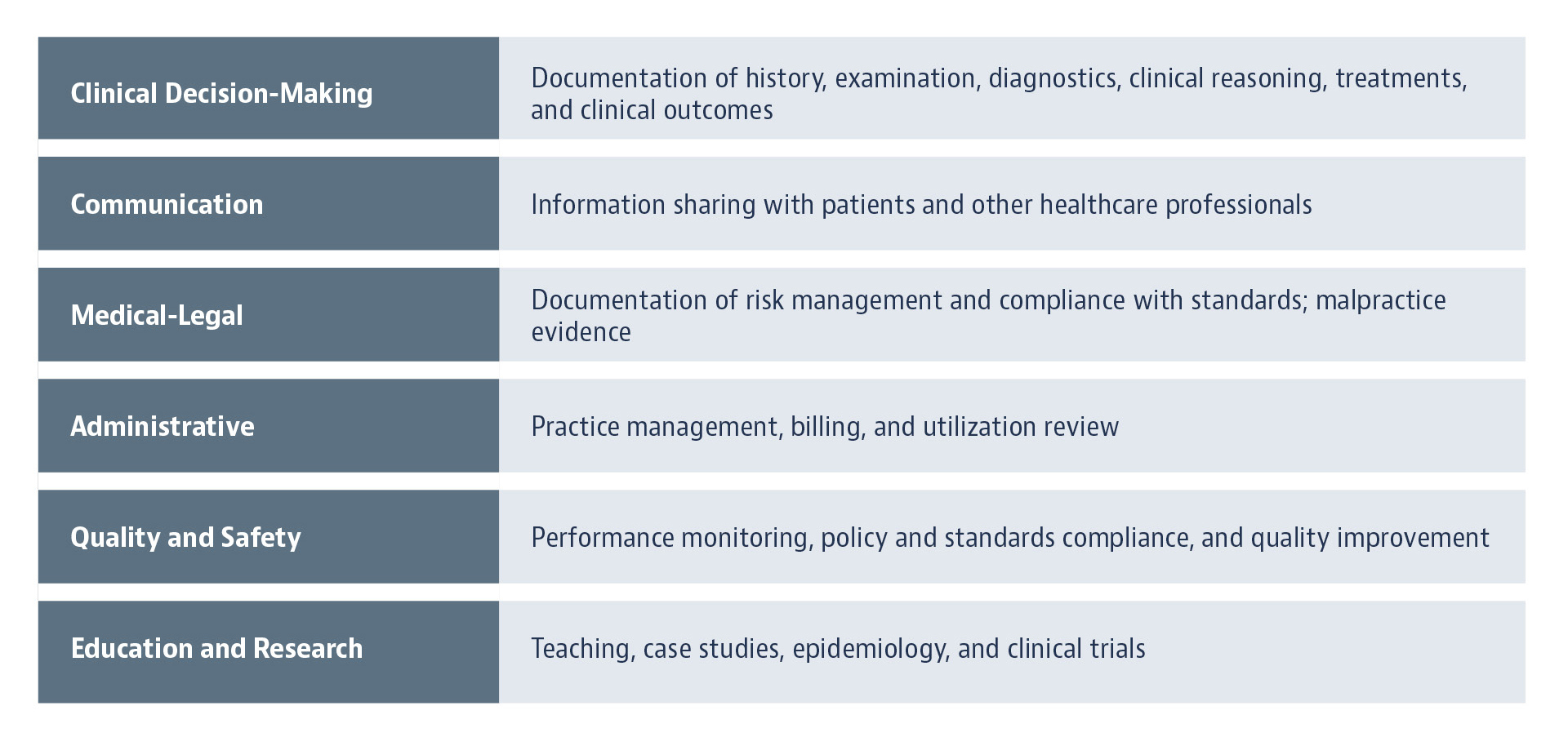
The EHR has largely become the primary source of professional communication across outpatient, inpatient, and emergency room practices.1 In addition to being the primary source of clinical information and integral to clinical decision-making, the EHR now fulfills several other important functions (see Table below).
To serve these functions well, the gains in timeliness and accessibility will have to be matched by comparable gains in the quality of the content within the clinical record. Current studies suggest incomplete clinical documentation remains a critical quality gap.
Incomplete Clinical Documentation
A recent publication on the quality of cancer recurrence documentation brings to light some of the ongoing challenges associated with achieving reliable recording of even key critical information such as cancer recurrence.2
The study published by Chan and colleagues demonstrates that while rates of data missingness improved since the introduction of the EHR, inconsistent clinical documentation of recurrence is still a significant problem. When surveyed, staff trained in gathering cancer recurrence information from the record disclosed that “no evidence of disease” and “recurrence” were not well-documented at rates of 67.8% and 50.5%, respectively.
Although inconsistent documentation requirements play a role, the problem also is attributed to the absence of a standardized process for determining disease-free status. Despite the high value placed on cancer recurrence information as a key cancer outcome, the authors concluded that further work is required to improve the quality of the data before recurrence information is publicly reported.
Given the greater reliance on the EHR for communication, particularly asynchronous communication, gaps in documentation of important clinical information takes on a new level of significance and urgency.1
The omission of noncritical information may be inconsequential, but the absence of critical information can adversely impact downstream patient care and outcomes. It should be pointed out that this problem is not unique to oncology. In fact, at least four healthcare specialties already have started addressing the problem by developing and implementing standardized synoptic reports.
Standardized Synoptic Reporting Improves Clinical Information Completeness
The narrative report has been used for decades to document the story of the patient, their medical findings, and their care. Narrative reports are typically dictated as free-text prose and because they are not standardized, they are well-suited for capturing nuance, reasoning, and contextual detail for each individual patient.
Conversely, because they are not standardized, these narrative reports are, unfortunately, prone to featuring significant omissions. Since medical records are a primary vehicle for communicating findings with patients and professionals, omitting key information in the record can jeopardize downstream clinical decision-making. Indeed, the introduction of synoptic reporting has brought to light the inadequacies of narrative reporting.
Synoptic reports are standardized and structured templates that capture predefined fields of information and emphasize completeness and consistency. Systematic assessments demonstrate that synoptic operative reports are more complete and often are more efficient and faster to finish than narrative reports.3
Colorectal cancer studies have shown that synoptic reporting captures 50% more information, including vital cancer information such as level of vascular ligation, distal margins, en-bloc resection, and cancer resection completeness.4 As mentioned previously, downstream decisions, such as the administration of adjuvant chemotherapy, made in the absence of key information (e.g., complete staging information), risk compromising patient outcomes, which limited studies support.4
It should be clarified that the narrative report has not been completely abandoned. In fact, most standardized templates are technically hybrid reports. Most standardized EHR templates achieve completeness by requiring synoptic responses to items considered part of quality-critical reporting standards, and they capture unique complications, judgment calls, unusual anatomy, or findings by including plenty of brief narrative options.
Another additional benefit of synoptic reporting is its capability to provide information succinctly and in a standardized manner for research, clinical trials, and quality improvement projects that are important for continued practice advancement and improvement.
Specialty Societies Support Synoptic Reporting
The greatest support for standardized synoptic reporting has come from the professional societies representing medical specialties, including gastroenterology, pathology, radiology, and surgical oncology.
This support is driven by the fact that specialty societies often establish evidence-based guidelines, best practices, quality programs, and research platforms. Accordingly, for each medical condition, these societies are well-positioned to provide guidance on key clinical information to be used as part of documentation standards and for inclusion in synoptic reporting templates.
In return for supporting synoptic reporting, specialty societies are afforded new opportunities for monitoring the implementation of their best practice standards and/or quality measures, such as what has been done with operative standards.5,6
The incentives and developmental pathways are ready and waiting for more specialty societies to get on board with supporting standardized documentation practices. This approach is the logical next step for any society wishing to monitor how their guidelines, best practices, and quality programs are being adopted in the real world. The standardization path forward for medical conditions requiring diverse specialty engagement is beyond the scope of a single specialty society and, as such, it necessitates greater national support.
National Efforts to Support Medical Record Standardization Across Specialties
In order to address the gap in documentation for multispecialty oncology practices, it will require two distinct efforts. The first effort would focus on developing and implementing synoptic cancer status reporting, similar to how operative standards documentation requirements evolved.6 Developing and implementing reporting requirements and technical solutions would likely meet resistance across oncologic practices and yet this solution would be the simpler effort.
The second effort would focus on establishing a standardized manner for establishing disease-free status and distinguishing recurrence from progression and from a new primary. Creating a single acceptable set of definitions for recurrence will require harmonization across disciplines where there is already some measure of discordance.2
Fortunately, this is not the first time the cancer care community has had to come together to solve common taxonomy and definitional problems. Indeed, the American Joint Committee on Cancer (AJCC) has for decades been successful at assembling diverse cancer stakeholders to produce, distribute, and support a single uniform cancer staging system.
Since improving the accuracy of cancer status reporting is an important key for further advancing cancer practices, a multidisciplinary team representing national stakeholders, including the AJCC, is meeting regularly to standardize cancer status definitions. Federal efforts under the Office of the National Coordinator for Health Information Technology that is focused on standardizing the healthcare record will hopefully accelerate the cancer recurrence harmonization work.
National efforts to standardize healthcare records and enable seamless sharing of patient records across systems are focused on creating common information/data formats, terminology, and exchange frameworks.
To ensure consistent clinical concepts representation, it is important to note the following the International Classification of Diseases, Eleventh Revision (ICD-11) provides a global standard for diagnoses; Systematized Nomenclature of Medicine—Clinical Terms (SNOMED CT) offers a comprehensive clinical terminology for diseases, procedures, and findings; and the Logical Observation Identifiers Names and Codes system standardizes laboratory and clinical observation results.
For reference, the AJCC staging system is linked to SNOMED CT and, as such, serves as a national standard. The US Core Data for Interoperability establishes a standardized set of health data elements (e.g., allergies), which must be shared across EHR systems.
The goal of the medical record is to support the healthcare information needs of patients no matter where, when, or with whom they seek medical care. Transitioning from paper charts to the EHR has improved the timeliness and accessibility of clinical information and, not coincidentally, the EHR has taken on greater importance as the primary source of clinical communication for healthcare professionals and patients.
Recent studies report that despite the widespread implementation of the EHR, there remain significant quality gaps in clinical documentation, even for such notable factors as cancer recurrence. Standardized synoptic templates have been used across a number of medical specialties to close information gaps and better support downstream decision-making.
Given the proven benefits of clinical documentation standardization and the progress made and being made on multiple fronts, now would seem like a good time for all healthcare stakeholders to lean in and take the record to a new level of completeness and quality.